You Need a System – Not a “Fresh Look”
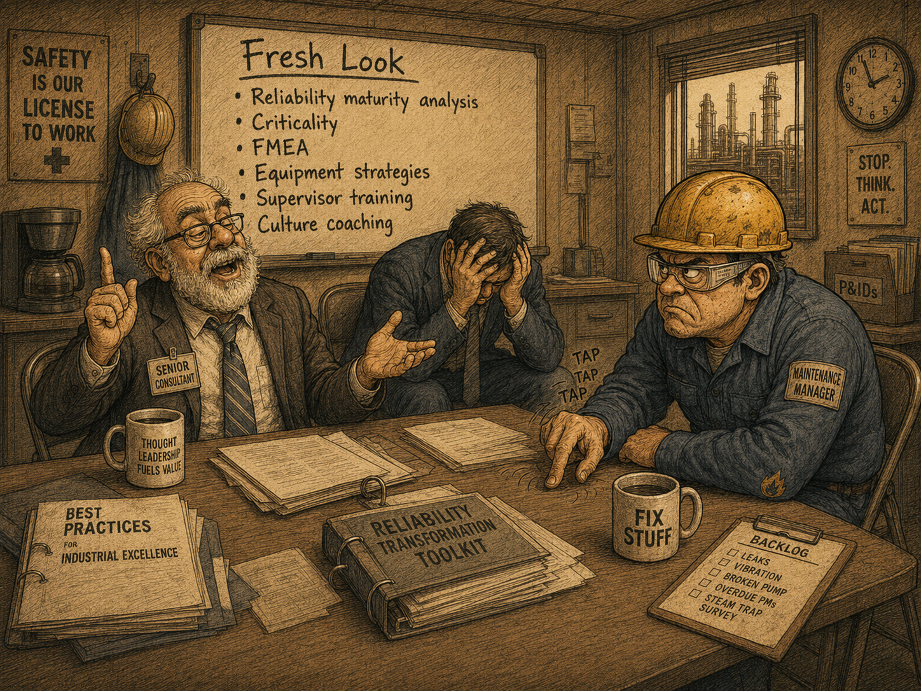
You get the email late on a Thursday afternoon that has already been one for the books. Your VP met someone at a conference — "graybeard, really sharp guy, thirty years in reliability, I'd like him to take a fresh look at our program" — and can you clear a couple of days next month for his visit.
You read it twice as the anger sharks start circling in your head. Then you close the laptop and stare at the whiteboard with the math still on it. This will be the fifth one in eleven years. All of them, including the corporate reliability team, arrived with a deck and departed with a slide of recommendations you had already made in writing, twice.
The only recommendation that got implemented was a “reorg” of the planning team and an attempt at a budget cut that the equipment blew past in breakdown maintenance.
You know how the visit is going to go because you've lived it. You’ll meet at the conference room in the turnaround trailer. There’s still stuff from the last improvement project written on the board there. The graybeard will come with a box of kolaches and a trove of war stories you don’t have time for. If he says, “I’m a consultant, I get paid by the word,” like the last guy, you may walk out.
He'll open a PowerPoint that hasn’t changed in design or content in decades. For a day and a half he will explain that reactive maintenance is expensive, that planning matters, and that it all starts with a valid criticality analysis.
You did a criticality analysis in 2014. You did another in 2019 after the merger, when the new corporate group decided the old scoring matrix was wrong. There's an RCM study in a binder on the shelf behind your desk — three thousand person-hours of workshops that nobody has opened since Safety said that it would all have to go through MOC after the facilitator's final invoice cleared. You've been through the culture survey, the CMMS migration, the operator-care rollout that lasted exactly until the first headcount reduction, and a "digital transformation" that broke the links to the PowerBI that everyone used and replaced it with a dashboard that most of your organization doesn’t have licenses for.
And you remember, with a precision that ought to worry you, everything you asked for across those same years and didn't get. The PdM tech position they absorbed in the 2020 reduction, taking the vibration routes with him. The lubrication program upgrade you priced at $100,000 — for real, tangible things — that died in the same budget cycle that approved a $200,000 reliability culture assessment. The calibrated torque wrenches. The parts-kitting pilot you asked to run on one crew. The planner they pulled to a capital project "temporarily" fourteen months ago. Your rotating specialist retires early next year, and the request for six months of overlap with his replacement is sitting unread in somebody's queue while the VP books consultants.
So, when the email says fresh look, something happens behind your sternum that you have learned to keep off your face. What you want to write back is not consistent with continued employment. What you actually write back is "Sounds good — happy to get it on the calendar."
The last manager here who told a VP an initiative was bullshit is selling insurance in Ohio now, and you're eighteen months from a kid in college.
The VP, for what it's worth, is as stuck as you are. He can't put "funded some stuff like oil carts" on a quarterly business review. He can put "engaged a nationally recognized reliability advisor." He buys the thing his world knows how to reward. He's not stupid. He's been handed the same broken menu you have — his just has consultants on it.
I have been on both sides of the folding table. From the consultant side, I’ve sat next to the consultant VP who said he gets paid by the word. The same guy later asked what an FD fan was and I wanted to crawl under the table.
I have seen the ancient slides. I have seen them updated into Accenture purple. I have seen the graybeards turn over “handbooks” to clients that were veneer thin truisms and completely unusable. I have rebuilt more decks, references, maturity maps, process maps, and references than I care to count.
I have seen the client VP and the consulting MD huddle and agree that they needed a graybeard – who came to maintenance consulting via used car sales and the loan officer desk (this is not rhetorical exaggeration and I have more than one example) – instead of the late-30s engineer who spent a decade in real plants moving from reliability to maintenance manager before spending another several years consulting with major clients around the globe.
Some of the work was genuinely good, and nearly all of it stopped one level above where your problems actually live. Your problems don't live in the strategy. They live in the eighteen inches between a sound maintenance idea and the hands trying to execute it: the PM acceptance criteria that would have found the seal flush issue, the torqued electrical connection (and the later thermography round) that would have caught the bad connection, the oil top-up that contaminated the gearbox, the part that showed up close enough but wrong, the induction heater nobody can find – and nobody bothers looking for anymore.
A few years ago, on our way out of a plant, the manager looked at my team and said, "You restored my faith in consultants. You actually get out of the trailer and you actually know maintenance." He meant it as the highest compliment he had. What I heard was an industry that had set the bar so low that leaving behind something people could execute on Monday morning had become remarkable.
Which brings us to the part that should make you angrier before it makes you hopeful: you were right the whole time. Every unfunded request on your list — the lube program, the vibe routes, the torque wrenches, the kitting, the overlap for the retiring specialist— was a piece of one system. You just never got to ask for it as a system and no one in the advice industry gave you or your VP for “permission” to ask for it as such. You asked for it as line items, and line items lose.
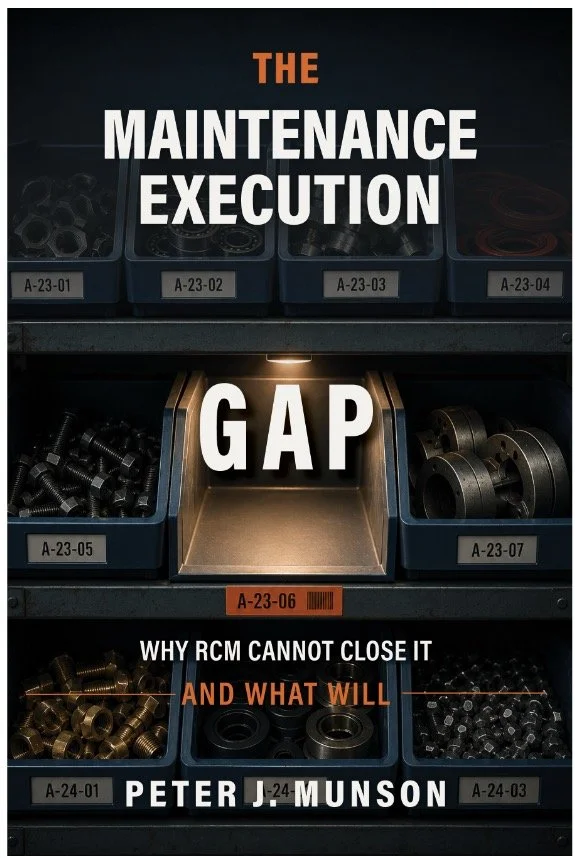
That's what The Maintenance Execution Gap is for. It won't tell you anything about your plant you don't already know — you diagnosed this years ago, in budget requests and outage reviews, on the record. What it does is assemble the argument you've been trying to make for a decade in the order a VP can hear it, with the evidence attached and an outsider’s voice, because we both know the diagnosis lands differently when it doesn't come from the man asking for the money. It names the conditions that have to be true at the point of work for a job to succeed, and it gives you standing to say the thing that has never been permitted in that conference room: stop funding another look at the problem, and fund the Maintenance Execution Framework.
Hand him the book before the next conference comes around with the same old answers wrapped up in an AI bow to tie you up with.
The book will be out on 21 July - learn more and read the first chapter here.