
The Permission Slip
Over a million dollars, eighteen months, and not one RCM strategy ever reached the field.
You've seen the whole show before: a consulting team that ran criticality on every tag, built the FMEAs, wrote the equipment strategies, and bound it all into a deliverable that was nowhere near the finish line.
Across those eighteen months, the plant cut headcount, swapped a plant manager and a production manager, stood up a different management system, and revised the MOC process — so by the time the strategies were "done," the org that commissioned them didn't exist anymore.
The XLS the consultants created had task and interval: visual inspection, quarterly. Those “strategies” needed review, planning to flesh out real detail (you’d hope), MOC (no one mentioned that until after the consultants left), and upload.
The plant took a look at all of that and deemed it too hard to complete.
Strategies actually implemented in the field: zero. Not one.
You watched it happen. And the whole time, some part of you knew a good mechanic and a good planner could've fixed the three pumps that caused you the most trouble in a week – for about what the project kickoff luncheon (complete with an icebreaker that had people playing with Legos) cost you.
I've been part of projects like this. The analysis wasn't wrong — it was aimed at a problem you didn't have. You never had an analysis gap. You knew what was breaking and why. What you had was an execution gap: the person holding the wrench was never enabled to execute defect-free maintenance with the proper information, materials, fluids, tools, uninterrupted time, and restart to ensure the job was done right.
Look at what actually stops a strategy between the XLS and the pump. The work order carries a task line that says "PM pump — check oil" and nothing about what "good" looks like, so the technician does what the text lets him do, which is glance and move on. The kitted materials include a gasket that is the wrong size and a bearing that has been corroding due to improper storage. The one torque wrench that reads in the range you need is signed out to another crew. The oil arrived at an unknown cleanliness code (almost certainly off spec) and then sat upright in a drum with moisture ingressing through the bung for months. None of that is a failure of analysis. Every one is an execution system failure, and the FMEA that took over a year to build has nothing to say about any of them, because it was never designed to.
That's the gap the book is named for, and closing it doesn't take another study. It takes providing the right knowledge, tools, materials, and conditions before the work starts — seven enablers, each one boring, each one non-negotiable, none of them requiring a workshop or a consultant's binder to stand up. You can start on your three worst pumps next week. The plant will teach you the rest faster than any analysis would have.
The advice industry has told you and your executives for years that you couldn’t do it this way. You had to start with master data cleansing, then criticality analysis, then RCM analysis, then training, then culture coaching… Always another phase on the horizon.
This book is the permission slip. Permission to skip the eighteen-month study and do the common-sense thing you already knew was right — put the job in front of the field with what it needs, and let the plant teach you the rest. You shouldn't need a book for cover to do the obvious, but the advice industry has spent the last forty years telling your executives otherwise.
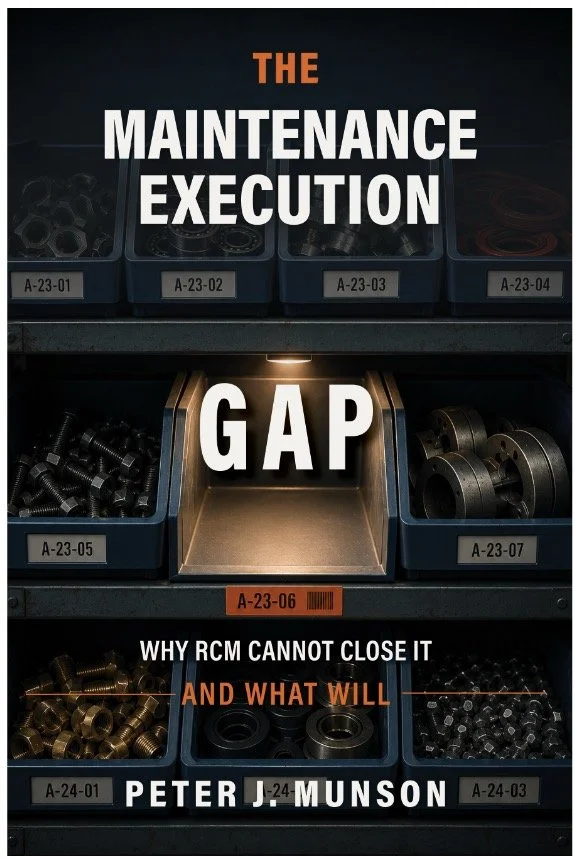
The Maintenance Execution Gap: Why RCM Won't Fix It… and What Will is available now — hardcover, paperback, and Kindle on Amazon, plus Nook and Apple Books.
