
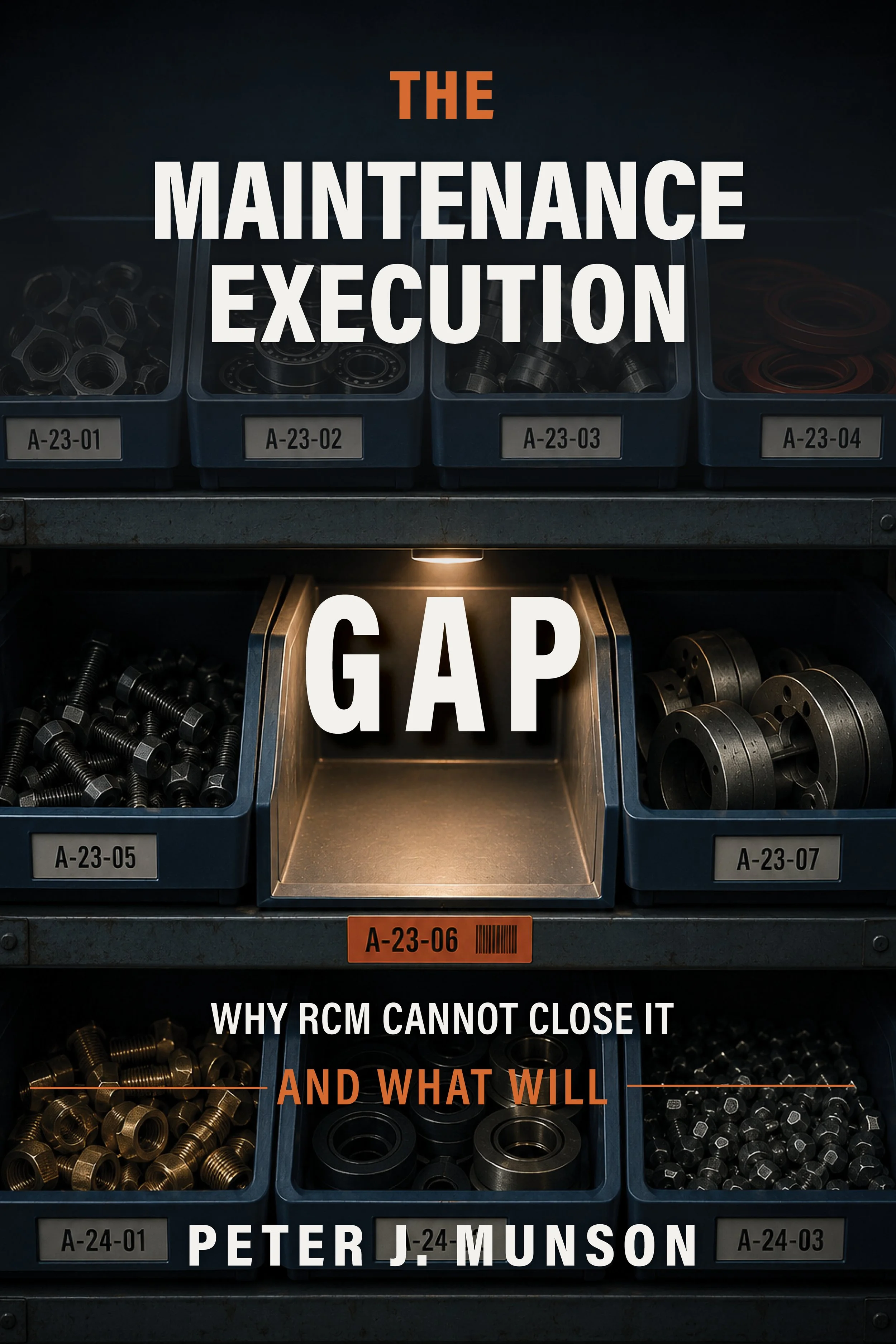
The Maintenance Execution Gap
Why RCM Cannot Close It…
and What Will
Peter J. Munson
Four decades of RCM, FMEA, and criticality scoring, and the same bearings fail the same way. The problem was never the analysis. It’s what reaches the technician’s hand when the work order opens — and what doesn’t.


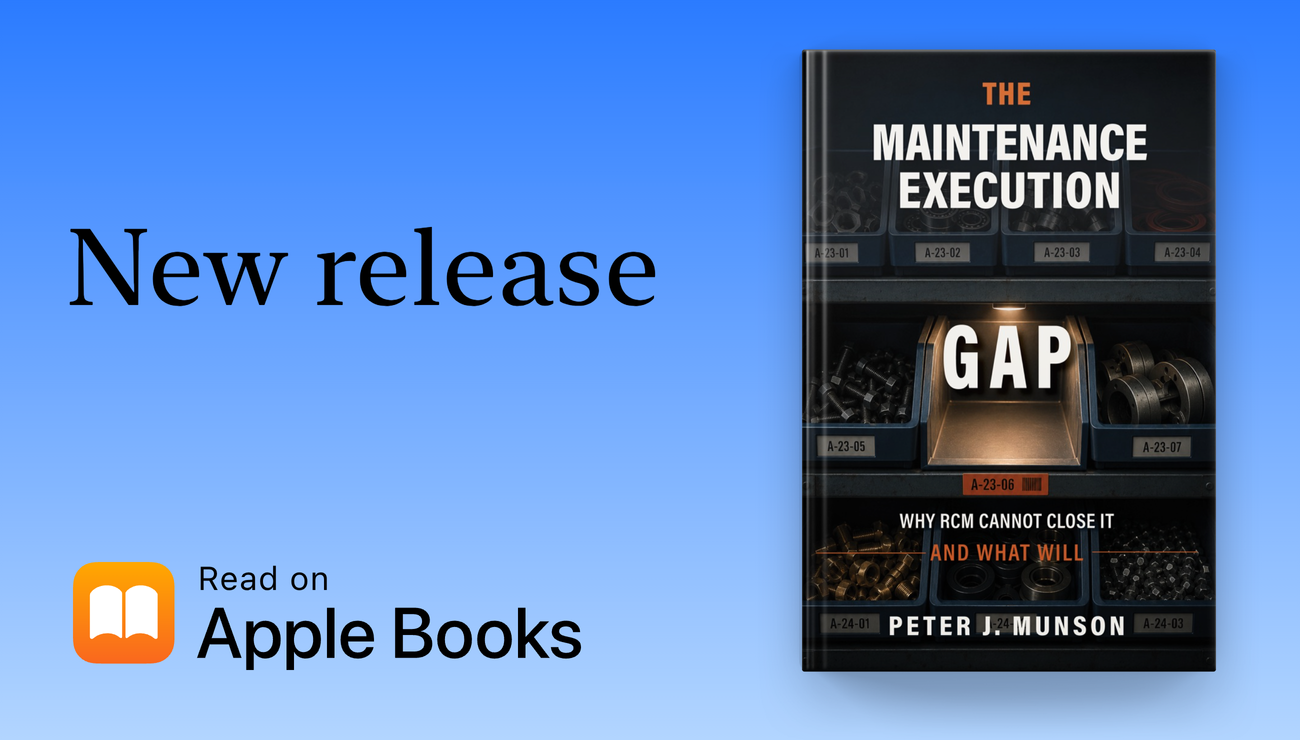
Get the book
Paperback, hardcover, and Kindle editions are available on Amazon. Nook edition available via Barnes & Noble. Apple coming soon.
EPUB and PDF are available direct from SamOS, watermarked to the purchaser.
Multi-copy and site licenses are available for teams and plants standardizing on the framework.
The argument, in brief
The reliability industry has spent forty years getting better at deciding what to do and no better at doing it. RCM asks what could fail. The analysis piles up in strategy documents while carbon-steel elbows corrode to credit-card thickness in the field. The binding constraint sits one step downstream of everything the profession sells: the moment a craftsman installs a bearing, a technician adds oil, an operator lines up a restart. Get the knowledge to that moment in the right form and reliability follows. Miss it and no amount of upstream analysis matters.
This book names that constraint the maintenance execution gap, shows why the industry’s dominant methods are built to address a different problem, and lays out the Maintenance Execution Framework that closes it.
What the framework does
The Maintenance Execution Framework rests on a single premise: prevention happens in the discrete moments a person touches equipment, and it depends on seven conditions reaching that moment together.
Execution References — the right knowledge, quantified and action-oriented, at the point of work
Proper Tools — the specific tooling the task actually requires, in hand
On-Spec Materials and Fluids — verified correct, not “close enough”
Equipment Access — the machine isolated, drained, and ready to be worked
Continuity — the job carried through without the handoff losing what mattered
Safe Restart and Operation — the equipment returned to service without inducing the next failure
Learning by Doing — what the technician found fed back into the reference the next person reads
Analysis tells you which failure modes matter. The framework governs whether the work that prevents them is actually enabled when it happens.
Who it’s for
Reliability engineers who suspect their RCM binders aren’t moving the needle. Maintenance and reliability managers watching PM compliance climb while reliability sits flat. Plant and operations leaders paying for reliability programs and not seeing them in the availability numbers. Anyone who has stood on a unit, watched a good technician do careful work off a one-line PM that said “Annual Pump PM,” and known something upstream was broken.
About the author
Peter J. Munson has worked in maintenance and operations for nearly three decades, starting as a Marine Corps KC-130 airframes officer-in-charge and pilot. He led the shop that maintained the aircraft he flew; his first look at a maintenance execution system he trusted with his own life.
He is a graduate of the Naval Aviation Maintenance Program Managers Course, the Aviation Safety Command Course, and the Marine Aviation Weapons and Tactics Instructor Course. He served across maintenance, operations, and general management positions before retiring from the Corps. The years since have been spent consulting and working in heavy industry, including refining, chemicals, utilities, and mining, on the maintenance, reliability, and safety problems this book takes apart.
He has earned the Certified Reliability Engineer (CRE), Certified Maintenance and Reliability Professional (CMRP), and Certified Reliability Leader (CRL) credentials. He is the author of Iraq in Transition: The Legacy of Dictatorship and the Prospects for Democracy and War, Welfare, and Democracy: America’s Quest for the End of History.
He founded SamOS Industrial Execution to put these systems into practice rather than admire the problem from behind workshops and slide decks.