
The Slop is the Method
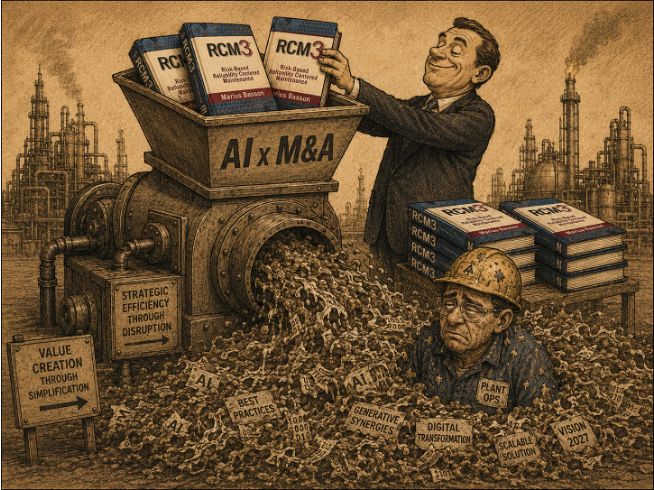
What do companies do with all that money when they’re cutting employees and not raising salaries? They buy more companies! M&A is all the vogue and one recent acquisition hits at the heart of the RCM toll gate.
Group Elephant — an enterprise software and consulting outfit — acquired Aladon, the company John Moubray founded and the closest thing the reliability world has to a franchise headquarters for Reliability-Centered Maintenance.
As a reminder, RCM started life as a specific answer to a specific problem. In the early 1960s, United Airlines engineers — Stan Nowlan and Howard Heap among them — worked through in-service failure records on a young jet fleet and found that most failures had nothing to do with age, and that scheduled overhaul was, for the majority of components, doing little but introducing fresh infant-mortality risk. The Department of Defense published their findings in 1978 as Reliability-Centered Maintenance, which replaced reflexive overhaul with a decision logic that asked what a failure actually costs before prescribing a task, cutting the number of time-based requirements by well over 90 percent. The result was a standard maintenance approach, fully documented once on a highly standardized and regulated fleet of nearly identical aircraft consisting of an order of magnitude less components than a manufacturing plant.
John Moubray took that airline methodology, founded Aladon in 1986, and generalized it for industry as RCM II — seven questions, facilitated workshops, eventually 600-plus sites across 32 countries. SAE codified this in 1999 as JA1011, whose foreword still traces the method straight back to Nowlan and Heap. His successor as president, Marius Basson, wrote RCM3 and built the family of methods around it — Reliability Centered Design, Risk Centered Spares, Maintenance Task Analysis, Asset Criticality and Prioritization — all delivered through Aladon's ACTOR software.
The franchise Group Elephant just bought is the far end of that line: a 1978 airline-fleet answer, generalized and re-generalized, now sold back to refineries carrying 100,000 tags whose pumps and exchangers were catalogued decades ago. The announcement said Group Elephant will bring its strengths in IT development, online training, AI, and system integration to "redefine how RCM is offered, delivered, and sustained."
That phrase describes selling and running the analysis engine more efficiently. Which is exactly what I told you to expect more of… when what you really need is improvements in how maintenance execution is enabled.
The thing being scaled
I have seen this work from both sides of the table. The RCM industry has convinced you to pay for consultants to ponder problems that were solved decades ago, call it rigor, and hand it over as a spreadsheet that will take weeks or months of your effort to make execution ready. They have convinced managers and engineers that to do anything else is malpractice. The real malpractice is that none of these companies have come up with a product that is salable. The product isn’t worth buying, so they sell you the process, knowing it will be too late once you see the outcome. They convince themselves otherwise, but anyone with an ounce of introspection gets an uneasy feeling about this before somehow rationalizing it away.
Your centrifugal pump fails on bearing wear, seal degradation, impeller erosion, misalignment, and cavitation. It fails that way at your refinery, at the refinery across the fence line, and at every refinery on earth. SKF, Timken, API 610, and the Hydraulic Institute wrote those failure modes down long before your youngest engineer was born. Convening a twelve-month workshop to rediscover them isn't analysis. It's ritual — and now there's a plan to run the ritual faster, at scale, with an AI assist.
Does the ritual work? We have forty-five years of data to answer that. Maintenance cost as a share of asset replacement value has sat in the same band since the early 1980s. Wrench time — the fraction of a paid craft hour actually spent turning a wrench — still runs around 28 percent against a world-class mark north of 50 that hasn't moved either. CMMS, mobility, IoT, digital twins, and now generative AI all arrived during that time period. The distribution didn't budge. Aladon's own literature concedes that the majority of RCM initiatives fail — a remarkable admission from the methodology's commercial steward, and a precise map of where the money isn't going.
Stop listening to the wrong people in the wrong rooms
The advice industry has created a parade of consulting approaches and books – none of which get to the key constraint facing your plant. What is worse, they tell your executives they’ll get a 20% “save” – really taking 20% out of your budgetary pocket – without touching the reality of execution.
Master data cleansing
Criticality analysis
FMEA
Equipment strategies
Predictive analytics
Planner training
Scheduling optimization
Classroom craft training
Supervisor coaching
None of these truly intersect with reality - they live at a level of abstraction from the real work. None of them focus on tangible things that your operators and maintainers need to do their job properly. They all divert your time and attention to conference room discussions and run out of steam and budget before anything has changed at the shop floor.
The Maintenance Execution Gap focuses on systemic, real enablers at the point of execution. RCM3 runs to fifteen chapters; thirteen or fourteen build out the analytical engine and implementation gets one.
For the overwhelming majority of equipment at the overwhelming majority of plants, the leverage sits in the last mile. Does the technician have the right execution reference scoped to the step in front of them, the right tools, on-spec materials and fluids, physical access to the equipment, continuity across the shift handoff, a safe restart, and a genuine chance to learn by doing? Get those conditions right and you stop building defects into equipment during the very maintenance meant to prevent them. Miss them, and no amount of upstream analysis — however elegant, however AI-accelerated — reaches the pump.
Point the AI at the last mile
I have warned in this blog and I warn in the book that the industry is going to get more of the same tired solutions, at a higher volume, quicker, and sloppier. It will only make your life worse. The Aladon acquisition is exactly what I warned about.
This isn’t an AI problem – the problem is with four decades of the wrong dominant paradigm in the maintenance and reliability advice game. Aim AI at the last mile and you get something worth having — the right procedure, assembled for the specific asset and the specific step, delivered to the person doing the work in a useful format. Use the money you saved on RCM analysis to buy real enablers.
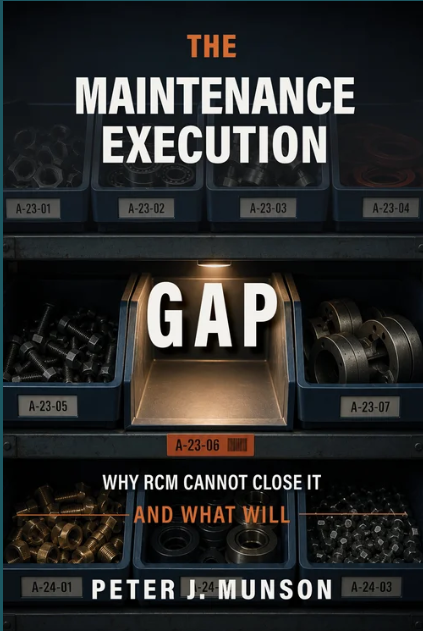
The book is available now
