
Maintenance is a Value Center… If You Treat It Like One
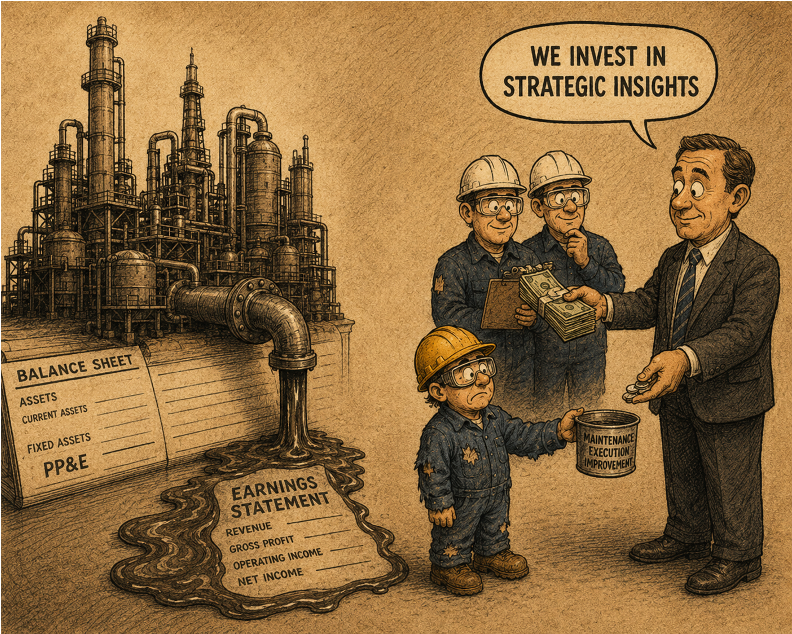
Industrial companies’ equipment makes up 40 to 60% of the value of their balance sheet. Gross, before the accountants have written off decades of depreciation, it carries far more. The steel keeps converting hydrocarbons every hour of every day. Every dollar of revenue is feedstock that physically passed through that equipment . The entire top line exists only while the equipment runs.
A function that holds half the asset base in its care, and on which all of the throughput depends, should be the most professionalized discipline in the building. In most plants it is run roughly the way it was run in 1985, on memory and luck.
The capital that buys the equipment moves through stage gates and investment committees before a dollar is spent. The control logic that runs it, written by process engineers, sits locked behind management of change. Its safety case is documented to IEC 61511 and audited on a fixed cycle. Then the same asset — the pump standing between Crude Unit 2 and sixteen million dollars a year of throughput — gets handed to a technician on a two-line work order, and what happens next turns on what he remembers and what he decides to check between the late start and the first break-in.
The reliability investment hasn't been absent. It has been spent upstream, on analysis. Over forty years the industry built RCM workshops, FMEA libraries, criticality matrices, and condition-monitoring programs — an entire apparatus for deciding what maintenance to perform and how often to perform it. Almost none of it reaches the ninety minutes when a journeyman is turning the wrench. The VP of Reliability has bought the diagnosis many times over and left the treatment to whoever happens to be on shift.
Show that VP a bad number — repeat-repair rate climbing in one unit, corrective volume climbing, the same mechanical seal failing three times in eighteen months — and the reflex is to demand better measurement. Break cost and quality down to the area level. Replace plant-wide mechanical availability, a number any production superintendent can puncture with a single bad-actor pump, with unit cost and volume by area, work-order aging on the production-critical population, rework and repeat-repair rates surfaced by condition monitoring. All of that is worth doing. I have implemented it myself. But, believing it is the cure is the most expensive mistake on the list.
Reporting your repeat-repair rate by area does not lower your repeat-repair rate. It tells you where to look. The area where the same seal fails and the planner cannot say why — what is broken there is the delivery of knowledge to the person doing the work, and no report, however finely disaggregated, reaches that far down.
Follow one of those failures to where it happens. A technician picks up a bearing replacement off a work order that reads, in full, "pump making noise, R&R bearings." The details of professional repair work – torque values, interference fit specifications, thermal growth adjustments, and on – are left to memory or buried in several different documents somewhere on a shared drive. The parts they are handed are a guess, because no bill of material exists – and they’ve been sitting in the Texas heat, humidity, and dust in an open warehouse for years. They don’t get torque wrenches from the tool room. There isn’t a working induction heater and there’s no press for the bearing installation. The oil they will use had particle contamination beyond ISO limits when it arrived at the plant. It has been compromised with water since the big rain earlier in the spring.
The pump isn’t ready when they get there. By the time they get started, the day is burning and they get pulled off to deal with three other issues throughout the rest of the shift. By the time the “repair” is complete, they have installed at least four ticking failure modes.
Professionalizing execution means providing the knowledge, tools, materials, and time required for a professional repair. The Maintenance Execution Framework creates the system that enables professional execution:
1. Execution Reference (the right knowledge, delivered the right way, at the point of execution)
2. Proper Tools
3. On-Spec Materials and Fluids
4. Equipment Access – The equipment is ready, in the right condition, at the agreed time
5. Continuity – Protecting technicians’ time focused on a professional repair
6. Safe Restart and Operation
7. Learning by Doing
None of these elements are new. Most of them are obvious. So, ask yourself why these are not systemically solved in every plant? Why do we keep putting effort everywhere but in execution?
This is not a worker problem. It is an engineering decision the VPs have not yet made: to design the point of execution with the same seriousness already spent on analysis and reporting. It is a resource allocation decision that the VPs keep deciding in favor of reliability process and against execution of asset care.
Professional maintenance enhances the bottom line and the top line. It deserves professional treatment.
Make that decision and the rest follows. The service-level conversation maintenance has lost for forty years — the one where it walks into the room holding availability percentages and walks out holding a budget cut — turns the moment execution actually moves the area number. When you can draw the line from a delivered Execution Reference to a seal that stopped failing to throughput the unit kept, you are no longer negotiating from a value you cannot demonstrate. The custodian of half the balance sheet finally has something to show for the role.
What closes the gap is execution engineered at the point of work — not another reporting layer, not another culture campaign. This is not an additive expenditure. It is a reallocation of resources from things that haven’t met their ROI promise for four decades and to the one thing every executive has tried, and failed, to cut – maintenance execution.
