
Maintenance Improvement: Participation Trophies or Pro Performance?
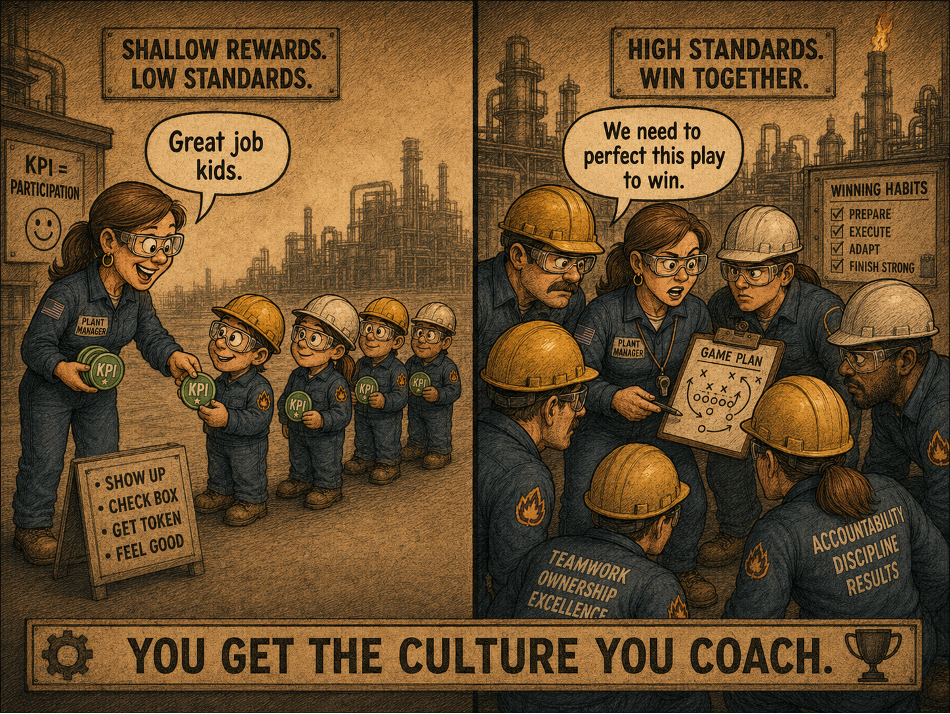
Most maintenance scorecards monitor everything and improve nothing. You need to focus on improvement, not measurement. Act like a pro.
You can find the accompanying KPI manual in our Practitioner Library.
Your plant probably has a wall like this – or more commonly now a dashboard. PM compliance sits at ninety-something percent. Schedule compliance is either 99% or in the 70s – neither is good. Overtime bounces between 10 and 20 percent. You likely have no recent measurement of your maintenance productivity. Fleet MTBF is years-long and has a stable trend line. Availability is green. Cost is tracking against the budget you swagged last year, except for that unexpected breakdown last month. Somebody updates the dashboard monthly, the leadership team nods at it for fifteen minutes, and then everyone goes back to fighting the same fires they were fighting last quarter. The dashboard is immaculate. The plant is no more reliable than it was three or thirteen years ago.
Industrial maintenance does not know what the score is. In most plants, there is no data to quantify the effectiveness of preventive maintenance. There is no data to quantify maintenance productivity. There is no data to quantify execution quality and repair effectiveness. Whether they realize it or not, most maintenance and reliability organizations are flying blind.
That is not to say that plants don’t measure. They measure constantly. The question is why all that measurement produces so little improvement.
What the status quo actually is
Strip away the software, and the status quo in most maintenance organizations comes down to one habit: continuous monitoring of a wide panel of mostly-lagging metrics, perhaps reviewed in a standing meeting, but not tied to a defined and disciplined improvement process.
We will address these issues in due time, after dispensing with the most fatal flaw: metrics as a self-graded report card. Most organizations treat metrics as a final grade, instead of the data on where to focus improvement. There is ample writing on this elsewhere, the most important of which circles around the healthy cultures that “embrace the red” as a guide to improvement and “challenge the green” to ensure the organization is not deluding itself. Most organizations are like little league teams, congratulating themselves over a good effort. Pro teams quickly move beyond the win to focus on went wrong, how to improve it, and how to keep winning next week.
Beyond this fundamental cultural shift, there are three other errors in the status quo that compound to cripple organizations.
The metrics are lagging, so they report the past instead of pointing at a lever. Overall equipment effectiveness or just mechanical availability is the headline score many plants use. By the time a declining trend is steep enough to survive a room full of people explaining it away — a planned outage here, a raw material issue there — the shifts that dragged it down are two quarters in the past. The work orders from those breakdowns are closed. The technicians who wrote them have moved on to the next emergency. The number tells you what the machines produced relative to what they could have. It has nothing to say about what is going to fail on Thursday. You are studying the crash in the rear-view mirror.
The panel is wide and the attention is thin. Watching fifteen numbers at once is not the same as improving one of them. Spreading focus across the whole board means no single capability ever gets the concentrated effort it would take to actually move. The dashboard asks for a little attention from everything and real effort toward nothing.
Nobody owns a number against a date. A metric reviewed without a decision is data collected for its own sake. When the monthly review ends with the charts noted and nothing assigned, those charts were wallpaper, however expensive the system that drew them.
Put the three together and you get exactly what the macro evidence shows: an industry that has industrialized measurement while leaving the thing being measured untouched.
How pros improve
You watch pro sports on nights and weekends, you may even “manage” a fantasy team, but when work rolls around we all want to play participation trophy league. That’s not how you get good.
A serious athlete monitors a few vital signs every day — resting heart rate, sleep, body weight, maybe heart-rate variability. These are not the point of training; they are the check on whether the body is healthy enough to train. They move slowly, and when one of them jumps, it is a warning that something is wrong.
Improvement happens somewhere else entirely. It happens in training blocks. The athlete and the coach find the limiter — the one capability currently holding performance back — and attack it with focused, concentrated work for a fixed period: a base-building block, then a strength block, then speed, then a taper. Each block targets one adaptation, drives it hard, consolidates the gain, and hands the focus to the next limiter. Nobody tries to set a personal record in every lift, every run, every week. That is not how bodies adapt, and it is not how organizations adapt either.
Monitoring keeps you honest about your condition. Focused improvement is what changes it. A plant that only monitors is an athlete who steps on the scale every morning and never works on improvement — perfectly informed about a body that never gets any faster.
The two-speed maintenance scorecard
The fix is to run maintenance metrics the way an athlete runs a season: a small permanent panel of vital signs, plus rotating campaigns that train one limiter at a time.
The permanent panel is four or five numbers you watch always, because they tell you whether the program is alive and whether you are hurting equipment.
PM data capture — whether technicians are recording real readings instead of writing "OK," the best single signal of whether your references mean anything to the people using them.
PM detection rate — whether your PMs are actually finding something, which tells you the program is sensing degradation rather than just consuming labor hours.
Induced failure rate — whether equipment keeps failing right after you touch it, which tells you maintenance is introducing the defects it was supposed to prevent.
A MTBF derivative — don’t let fleet MTBF lie to you – but you can keep MTBF from lulling you and your engineers by measuring the percentage of equipment with MTBF less than one year, for example.
Reactive maintenance ratio — the share of work that is unplanned, which tells you whether the crew has any capacity to improve or is just absorbing emergencies.
These are vital signs. They are not improvement projects, and every temptation to turn them into quarterly targets should be refused.
The campaigns are everything else. Pick the one enabling condition most clearly failing at the point of work — for example, continuity. Crews are unable to finish their work in one go due to break-ins. Stand up the two or three indicators that measure that condition. Break-in percentage has been a measure forever and has done nothing to change behaviors. For a defined period, measure percentage of invalid break-ins, percentage of jobs disrupted by break-in work, and percentage of break-in jobs ready for work when the crew is pulled off for them. Supervisors will have to manually collect this data, but it is for a limited time and a defined purpose – and the numbers will be startling in most plants.
Drive them to a target over a fixed block, usually a quarter. When the target holds, write the gain into standard work, retire those indicators to an occasional audit, and move the focus to the next limiter. Two or three situational metrics at a time is the ceiling for a team that actually intends to act on what it measures. Never run more than three leading indicators at once, match them to the improvement you are working on, stabilize, then move to the next.
That is the difference between a dashboard and an improvement program. The dashboard asks you to watch twenty things forever. The improvement program asks you to watch five forever and fix one at a time.
Monday morning
You do not need a platform to start. You need to do three things this week.
Name your permanent panel. Five vital signs, no more. Put them somewhere the crew walks past, not in a slide deck that surfaces once a month.
Find your limiter. Walk the floor and ask where the work breaks down. You will not have to look hard. It is usually the same answer the technicians have been giving for year. Pick the worst one.
Run one campaign. One asset class, one limiter, two or three indicators, ninety days. Drive the number, lock the gain, then choose the next limiter. Do not build the wall of twenty. Build the vitals and one block.
The wall of green dials is the comfortable choice, because it looks like rigor and asks nothing of anyone. Four decades of that comfort have left the core numbers of this industry sitting roughly where they started. Monitoring was never going to be enough. The plants that pull ahead will be the ones that stop admiring the scoreboard and start acting like professionals.
You can find the accompanying KPI manual in our Practitioner Library.
