
The Maintenance Execution Gap: A 90-Second Test for Your PM Program
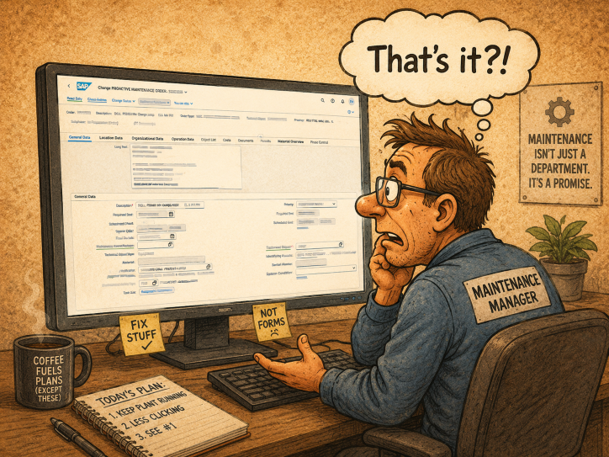
Pull the preventive maintenance work order for a few of your critical centrifugal pumps. The one whose seal lets go and walks the tower overhead out of spec before you've finished the incident notification — and now you're cutting charge. Or the finicky one that's failed so many times it has a nickname, runs fine for a month, then takes another seal.
Read the long text – if there is one. Not the description field. The actual instruction the technician sees standing at the equipment.
At most plants I have worked, it is some version of this: PM pump. Check oil.
That is the entire instruction set for a machine whose bearing life turns on oil-mist delivery and a housing-temperature trend and whose seal depends on a flush-plan pressure relationship the vendor specified in the seal support package. The knowledge exists. It is in the vendor manual, the seal plan, the standard, the equipment file (in someone’s shared file), and the heads of people already inside your plant. And the second-year technician has none of it in front of him. He has check oil. No acceptance criteria, no IR thermometer, no vibration pen to quantify the bearing noise that has popped up since the vibe round three weeks ago.
So, he checks the oil and signs the work order, and compliance closes at a hundred percent — while the detection rate of that PM, the rate at which it actually catches the thing it exists to catch, sits at zero.
That gap, between a compliance number that looks healthy in the Monday meeting and a detection rate of nothing, is the sieve your reliability budget has been draining through for years. You can pour more analysis into the top of it. You can run another RCM study, buy another predictive platform, send another cohort to another certification. The effort still runs out the sieve, because not one of those things changes what the technician sees at the moment the work is done.
I spent the better part of a decade inside the advice industry that sells the “good ideas” pouring into the sieve. I have watched good analysis get bound, shelved, and never reach the person whose hands were on the equipment. The industry is genuinely good at telling you what should be maintained and how often. It has built almost nothing that determines whether the work, when it finally happens, adheres to any standard, much less one that is written in the order.
The knowledge to maintain that pump correctly was never the scarce thing. The bearing tolerance is free. The flush pressure is on a drawing. Heinz Bloch set down the precision and contamination-control practices that prevent the damage in books that have sat on reliability engineers' shelves since the 1980s. What is scarce is the assembly — the work of turning those scattered, freely available facts into something any technician can execute the same way, finding the right defects, every time. That assembly is skilled work, and it is the work the industry has not gotten to in forty years. All of the effort has been upstream in RCM analysis, training, and culture.
I have spent the last several years building that assembly, and writing down why nobody else did. The whole case — why execution rather than analysis is the binding constraint on reliability, and what the system that closes the gap actually looks like — is a book called The Maintenance Execution Gap, and it will be out this summer. Over the next few weeks I am going to preview its logic, one constraint at a time: the defects you unknowingly introduce every time the equipment is touched, the reference the technician never receives, the storeroom that quietly fails the entire program, the restart that turns a repair into a process upset.
You do not have to wait for any of it to start. Go back to that work order and count the acceptance criteria written into it — the actual numbers a technician could measure against and know whether the pump passed or failed the PM. At most plants the count is zero. That ninety-second exercise is the diagnostic. The question is: what will you do about it?
The answers are available. I have collated many of them at the SamOS Practitioner Library. You can build the system yourself if you have the people and the discipline. But don’t pay someone to spend eighteen months to rediscover what is already on your own shelf. SamOS is here for those who want to deploy what is already assembled and tested against real plants.
Open your CMMS and see where you stand.
