
On-Spec Fluids and Materials
This blog post is supported by a full Fluid Management Program Manual in our Practitioner Library. A Material Reliability Lifecycle Manual is coming soon.
Industrial maintenance has spent four decades arguing about equipment strategies — which RCM methodology is the “only acceptable one”, whether FMEA captures the right failure modes, which APM vendor has the best failure-mode library — all of it conducted upstream of the question that actually decides whether any of the analysis matters: is the part that comes off the shelf the right one in the right condition for full inherent reliability from day one? Far too often, the answer is “no,”, and the gap between what the system assumes (new part, no failure mechanism initiated) and what the storeroom supplies is a defect chain that no analytical methodology touches.
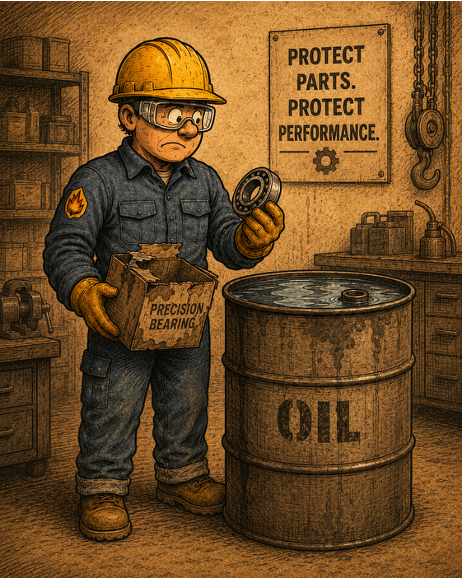
A bearing arrives at a refinery. It is shelved in ambient Gulf Coast humidity for nearly two years of thermal cycling. At some point, a technician opens the packaging for a job, but then the part is not needed and returned to the shelf. Two months before the job, a roof leak soaks one corner of the cardboard box; the box is restacked and forgotten. When the technician opens it at the bench, the bearing appears visually unobjectionable. But it is no longer the bearing that arrived from the manufacturer. The moisture and temperature cycling has initiated corrosion staining, etching, and microscopic pitting on the precision contact surfaces. Those defects may be invisible in a routine bench inspection, but they matter under rolling contact. The tech hammers the bearing onto the shaft with a steel pipe because there is no induction heater, oven, or cryo bath and the shop doesn’t even think of those methods. The corrosion has created microscopic weak spots that exacerbate the damage from the installation method, particularly in the form of brinelling. The newly installed bearing comes with stress risers that overcome the oil film and additional initiation sites for further micropitting and spalling.
The bearing will fail well before its L10 life. When it does, the failure will be attributed to manufacturing variability, to operator error, or to whichever upstream cause is closest to hand, because the actual cause — a precision part treated as ordinary inventory for months and a five-minute installation — sits in a part of the chain that most reliability programs do not look at.
The Supply Defect Chain
Start with the lubricant,. New oil shipped from a major distributor in a sealed fifty-five-gallon drum arrives at ISO 4406 cleanliness codes in the 19/17/14 to 21/19/16 range, where the OEM cleanliness target for a precision rolling-element bearing in critical service is 16/14/11 or cleaner — two to three ISO codes dirtier than the bearing housing it is about to fill, and an ISO code is a factor-of-two difference in particle count per category. Industry sources commonly attribute roughly half of premature bearing failures to lubricant contamination, with a larger lubrication-related share when incorrect lubrication, insufficient lubrication, and contamination-driven corrosion are included,, and the oil that causes those failures is generally off-spec before it ever leaves the storeroom. Clean, on-spec oil keeps moving surfaces from contacting each other. Particle contaminants travel through these spaces, overcoming film strength, transmitting stress, and causing wear and defects that continue to degrade. Water contamination compromises oil viscosity, reducing film strength and allowing metal-to-metal contact. Having both forms of contamination is likely without a full lubrication program and is extremely damaging.
Storage degradation affects nearly every material class in the warehouse if it is not deliberately managed. Elastomers age from cure or manufacture date, not receipt date, and shelf-life treatment varies by polymer family, storage condition, and governing reference. Stored motors absorb moisture if the storage environment is uncontrolled and anti-condensation heaters are not energized where required; the insulation resistance reading at energization tells you what the storage program did to the asset. Mechanical seal faces are micron-level precision surfaces, and once protective covers are removed, handling damage or particulate contamination can compromise the sealing surface before the part ever sees a stuffing box. VFD electrolytic capacitors lose forming condition during long unpowered storage, with OEMs commonly requiring reforming or controlled energization after one-to-two-plus years depending on model and storage duration.
All of this is decades-old material behavior, documented in OEM technical literature and in the published standards above, and routinely ignored in process-industry storerooms because no single function has been assigned to know about it.
Procurement contracts have historically been written against unit cost rather than against arrival condition. Receiving inspections check the packing slip rather than the part. Storage facility design was set by warehouse footprint constraints rather than by material-class environmental requirement. Periodic in-storage maintenance — the quarterly shaft rotation, the annual megger test, the capacitor reforming, the cure-date audit — was never assigned to anyone with calendar authority. Pre-installation verification at the point of issue is treated as an optional courtesy rather than a procedural step. The chain has eight or nine links and a typical plant has none of them under deliberate management.
Why analytical methodologies miss this
The thing reliability methodologies do not see, given the data they are built on, is the asymmetry of evidence between failures and non-events. When a failure happens and the bearing is recovered for analysis, the surface damage from improper installation and the storage-related etching are present together on the same raceway. The post-mortem cannot easily separate them, and the more visible mechanism — the brinelling from the steel pipe, the contamination in the oil sample — gets the attribution. When a failure does not happen — when a properly procured, properly stored, properly installed bearing runs to its design life with no incident — the storeroom and the installation method that made that outcome possible leave no evidence in the CMMS, because non-events are not recorded. Methodologies built on failure data therefore systematically underweight the upstream supply chain, whose signal lives in the failures that did not happen.
An RCM workshop will identify oil contamination as a failure mechanism for a centrifugal pump bearing without ever asking how the oil got contaminated – and it will specify oil sampling from the machine as a mitigation. In most plants, the oil was already off-spec at delivery and the storeroom transfer practices made it worse. A failure-mode-driven PM library will specify oil change intervals without specifying cleanliness targets or moisture contamination limits at the point of application. The methodologies do their analytical work, the storeroom defeats it before the work order is ever issued.
The defect chain is multiplicative because each link compounds the next. Off-spec arrival contamination becomes worse in unsealed bulk storage, usually with moisture content rising, too. Bulk-storage cleanliness becomes worse during transfer through a plastic funnel that has been sitting in the dust. Transfer contamination becomes worse during top-up from an unfiltered can.
The same multiplicative behavior applies on the spare-parts side: unverified incoming inspection accepts a bearing whose packaging is compromised. A humid warehouse compounds the packaging compromise into corrosion. The absence of pre-installation verification at issue allows the corroded bearing to leave the cage. A steel-pipe installation finishes the job that storage started. A plant that addresses one link out of four has not solved one quarter of the problem. It has solved approximately none of it, because the failure mode is the chain rather than any of its individual links.
The implementation problem is structural
This gap has been visible at every site I have seen in three decades, without exception, and the practices required to close it have been documented in the same set of published references the whole time. They sit in SKF and FAG bearing handbooks, in NEMA MG 1 § 14.21 for stored motors, in SAE ARP 5316 for elastomer shelf life, in J-STD-033 for moisture-sensitive electronics, in IEEE 43 for insulation testing, in NETA MTS for switchgear maintenance, in IEC 60721-3-1 for storage class envelopes, in 40 CFR Part 279 for used oil handling, and in API 686 for general installation practice. The evidence is decades old, freely available, and unfamiliar at most plants not because nobody knows what it says, but because no single function has ever been assigned to own it end-to-end.
Procurement reports through one chain and is measured on cost variance. Stores reports through another and is measured on inventory turns and stockout rate. Receiving is measured on documentation completeness against the packing slip. Maintenance is measured on schedule compliance and wrench time. Reliability engineering is measured on PM completion and bad-actor reduction. Each function is doing what its scorecard rewards, none of them is responsible for the on-spec condition of the part or fluid at the point of issue, and the gap between what the Execution Reference specifies and what the physical environment supplies has never had a named owner.
The remedy is the assignment of that ownership before any of the technical practices are stood up. This is not a new concept, but few organizations have given it the attention it is due. Like the other execution issues we have discussed, it is seen as “icing on the cake,” precision, advanced. It is foundational and is a key element of the sieve.
A managed fluid program needs a single fluid program owner with cross-functional authority across procurement, stores, in-service oil analysis, and point-of-application transfer. A managed materials lifecycle program needs a single Materials Lifecycle Owner with cross-functional authority across procurement, receiving, storage facility design, periodic in-storage maintenance, pre-installation verification at issue, and obsolescence disposition. Without a named owner, the program is the sum of seven well-meaning functions each running its own scorecard — which is what every plant has today, and which is why the storeroom is the way it is. With a named owner, the technical practices follow.
What the programs actually buy you
The cost of either program is small relative to the scope of investment most plants are already making on reliability. If there’s any question, start with the fundamentals before any more analysis, software, or other consultant retirement program. A managed fluid service running filter carts, oil analysis, contamination control, and in some plants a third-party lubricator inside the fence is procurable at a fraction of the cost of the consulting engagement that produced last year's equipment strategy work. A materials lifecycle program, at the procurement decision level, is an assignment memo, a CMMS attribute change on Tier 1 stock items, and the establishment of a small set of receiving actions and recurring in-storage PMs. The operational rollout takes a few months but does not require capital authorization. The reason these programs remain uncommon in industry is that they are almost always seen as “advanced” or next steps after everything else is under control, and the upstream investment in analysis and strategy has absorbed the attention and the budget that would have been better spent on the supply chain those upstream investments ultimately depend on.
Every Execution Reference for a precision maintenance task carries a set of supply chain requirements inside it. An ER for a pump bearing replacement specifies the part number, the bearing fit class, the housing torque value and sequence, the preservation grease, the lubricant grade and cleanliness target, the cleanliness verification at point of application, and the post-installation runout acceptance criterion — and those specifications are, by their nature, a procurement specification, a receiving standard, a storage requirement, and a dispense-point protocol bundled together in one document. The work of translating them into purchasing language, supplier qualification criteria, receiving inspection content, storage segregation rules, and point-of-issue verification has historically been left undone, not because the source content does not exist, but because no function has read the ER through the lens of its own scope of work.
The two program manuals on the SamOS site are that translation. The Fluid Management Program Manual handles the lubricant and hydraulic fluid side of the supply, covering supplier specification, receiving sampling and ISO 4406 verification, segregated bulk storage with desiccant breathers, color-coded filtered transfer carts assigned by viscosity grade, point-of-use cleanliness verification on Tier 1 fills, used oil handling under 40 CFR Part 279, and the managed services tier matrix from product-only supply through full third-party lubrication.
The Materials Reliability Lifecycle Manual (coming soon) handles the bearings, mechanical seals, motors, switchgear, transformers, electronics, instruments, elastomers, and rotating spares on every other rack in the storeroom, covering procurement and counterfeit-control discipline, incoming inspection by material class, storage facility environmental controls, the per-class storage rules from elastomers through batteries, periodic in-storage maintenance routes, pre-installation verification at issue, return-to-stock disposition, and program KPIs and governance.
Both share the same structural pattern — single named owner with cross-functional authority, materials-criticality classification that does not collapse into plant criticality, per-section implementation roadmap with artifacts and CMMS system-of-record placement, and an explicit ninety-day program launch schedule — because both face the same underlying organizational reality, which is that no plant has spare functional headcount for a workforce dedicated to this work and the programs have to be designed to land on existing roles with explicit authority.
The argument for either program is the same argument that justifies the precision installation tools, the calibrated torque wrenches, and the laser alignment kits the proper-tools program asks for in the first place. The Execution Reference is the knowledge delivery mechanism; the physical enablers — tools, materials, fluids, and the supply chain that produces them on-spec at the point of use — are what make execution of that knowledge possible at all. A plant that has built one without the other has built half a reliability program, and most plants have built less than that. The work of fixing it is sequential, ordinary, and almost entirely within reach: name the owner, write the specifications down, change the receiving protocol, fix the storage zones, load the in-storage routes as CMMS PMs, and verify at issue. None of it requires a methodology that has not already been published, and none of it requires permission the plant does not already have.
The bearing in that box was a good bearing, doing what bearings do, until the system that handled it produced a defect on the way to the shaft. The system is the part the plant can change, starting Monday, without capital authorization or methodology debate — and the reason this argument should not be controversial is that every line of it has been published, in books and in standards, for forty years.
