
The Maintenance Revolution is Operational - not Analytical
For decades we’ve clung to the belief that if we could just get the analysis right – one more “world-class” RCM try – we’d finally crack the code of reliability.
But plants don’t fail because they haven’t analyzed enough, they fail because they don’t execute what they already know.
In my earlier post, I argued that RCM was a solution to a 1960s aviation problem that metastasized into a universal religion. The result: industrial organizations spend extraordinary amounts of time thinking about reliability and almost none ensuring the work actually produces reliability.
Based on data from plants we’ve worked with, many preventive maintenance programs have essentially zero correlation with failure prevention. In some cases, doing more maintenance actually increases failures. PMs, especially intrusive PMs, introduce defects that result in failures. This is especially likely in plants where people are constantly called away to fight other fires.
That’s not a analytical methodology problem. That’s a reality problem. And it demands a new operating philosophy.
The Two Questions That Actually Matter
When you strip away 50 years of frameworks, diagrams, workshops, spreadsheets, and consulting ceremonies, reliability comes down to two questions:
1. What does the plant need to operate safely right now?
2. Does the work we perform actually prevent failures?
Everything else is noise, but most organizations and consulting projects focus entirely on the noise without answering either of the key questions clearly. They substitute proxies—criticality scores, heat maps, task lists copied from somewhere, workshops where we pretend to rediscover well-known failure modes. We need to flip the model by refusing every abstraction that keeps us from seeing the real operating system of the plant.
Operational Reality Over Analytical Ritual
This is the first and most uncomfortable principle: the plant already knows what matters.
Criticality assessment bury that knowledge in a lot of meetings and talking that ends up in folders, spreadsheets… CMMS fields that never change a prioritization or equipment strategy decision.
We need to throw the scoring systems out the window. In their place, use a brutally simple question:
What is the minimum set of equipment, safeguards, and conditions required to run this system safely?
You know which defects are tolerable, which are dangerous, and which demand immediate action. You replace years-old “criticality” with real-time context—redundancy, degradation, operational mode, and system health.
You can start using this immediately as a simple question. You can refine the method and codify the results as you execute and learn. You do not need a criticality project. You need to apply operational clarity, not analytical elegance.
The Hidden Catastrophe: Execution Failure
If the first failure of RCM is its obsession with analysis, the second is its divestment from execution.
· FMEAs that result in “recommendations” or “scope” – not executable jobs
· “New” PM plans and work orders that never make it out of the shop – and are almost never read – resulting in craft doing the same thing they’ve always done
· Condition monitoring and analytics that are not “reviewed by an engineer” in time to be acted upon
· AI/ML meant to predict a failure in months, maintenance practices that induce failures today
We’ve built entire reliability programs on the assumption that “if we design it, execution will follow.” Instead, we got an industrial-scale illusion.
So SamOS introduces a second non-negotiable:
Do not execute work that doesn’t work.
Skip RCM.
Implement common sense things. (Veto the “what if” chin strokers who resist change.)
Analyze the effectiveness of what you execute
Stop doing what doesn’t work – because doing ineffective maintenance on critical equipment is worse than doing nothing—it consumes labor, introduces defects, and gives leadership the most dangerous thing in the industrial world: false confidence.
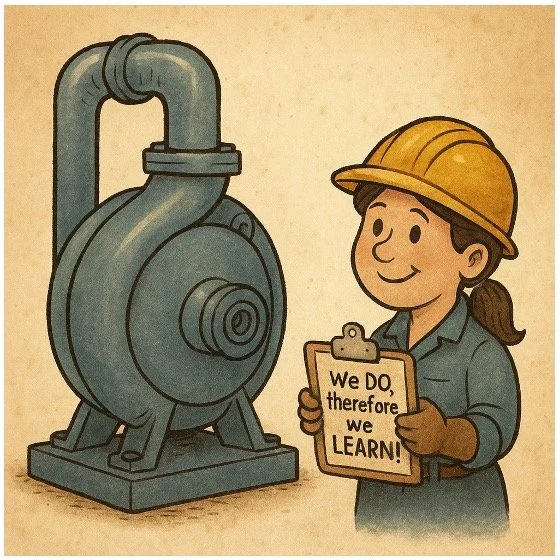
Learning as a Product of Doing
Most organizations produce work orders. Few produce learning.
Do what is important. Document what you do. Review documentation of real actions and findings to continuously improve.
Require every executed job to provide the minimum data needed for continuous improvement—fault found, failure mode, detection method, action taken, condition after.
All CMMS provide this capability. You don’t need a new app. Just use what is there. And you don’t need a ton of configuration of “mandatory fields.” Create a virtuous circle of action and learning.
· Technicians execute
· Technicians document
· Supervisors and engineers review the reporting and collaborate to improve maintenance plans
· If technicians are not documenting, it will show in the reporting
· If supervisors and engineers are not reviewing the reporting, nothing will change – because if the organization is not learning, it is dying—slowly, expensively, and predictably.
Deployment, Not Discovery
How do we just start executing without an RCM analysis? The answer to this requires exploding another myth: that every site is unique. That every pump must be rediscovered through a fresh RCM workshop. That every engineer must re-invent 120 years of known failure patterns.
In reality, industry knowledge covers 80–90% of common equipment.
We treat this not as a revelation but as a baseline. Strategies come pre-built. Job plans come pre-built. Detection methods come pre-built. Local modification is allowed only when justified by reality—not culture, preference, or a consultant’s time sheet.
This is how you break the cycle of reinvention and move toward a true operating system rather than a perpetual consulting engagement.
The Quiet Revolution: From Analysis to Operating Logic
The shift SamOS offers isn’t another framework. It is a return to operating truth:
· Know instantly what matters
· Stop doing work that doesn’t work
· Don’t schedule fantasy work
· Learn from every job
· Run the plant with clarity, not hope.
It is a transformation from an analytical worldview, where reliability lives in workshops and spreadsheets, to an operational worldview, where reliability lives in decisions, behaviors, and work that actually works.
Most industrial plants are drowning in analysis but starved for execution. SamOS is the architecture for ending that starvation.
And once you see the plant through this lens, it’s impossible to unsee it.
