
Letting Go of the RCM Myth
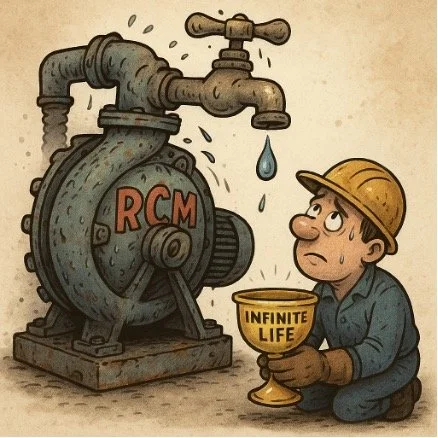
For decades, Reliability-Centered Maintenance has been imagined as the Holy Grail for industrial plants. It has yet to yield eternal youth for equipment. In fact, RCM as a plant-wide implementation has rarely achieved anything, but the Knights of RCM are happy to keep chasing – on your dime.
Engineers love the rigor, consultants love the billable hours, executives love the promise of “world-class reliability.” But here’s the uncomfortable truth: RCM as originally conceived solved a highly specific problem for standardized fleets 1960s jet aircraft under the watchful eye of FAA regulators. It has never been the right paradigm for improving maintenance performance across much less uniform and mature industrial facilities.
And somehow, over the last thirty years, we’ve managed to make it even worse.
The Analytical Trap
Engineers are analytical by nature. Consultants, doubly so. You give them a methodology—especially one laced with probabilistic math, logic diagrams, and failure tables—and they will enthusiastically rebuild it from scratch every time, confident that this time they’ll get it right.
Engineers love math. They love talking about beta and eta and the mystical predictive power of Weibull analysis.
But here’s the truth: unless you have large fleets of identical assets with excellent historical data—think aircraft engines or utility transformers—Weibull analysis is mostly noise dressed up as insight.
For the average pump, compressor, motor, heat exchanger, conveyor, or fan in an industrial plant, Weibull analysis tells you nothing you didn’t already know.
Even worse, it creates the illusion of precision.
The result?
Plants spend months, even years, and millions of dollars “doing RCM”:
Running full criticality analyses that don’t move the needle on reliability focus, much less end work prioritization infighting
Rebuilding equipment strategies for assets whose failure modes have been well-understood for decades
Generating outputs that never quite make it into the CMMS the way they should
Producing work orders with steps so generic or incomplete that technicians ignore them.
Every plant manager knows the pattern:
A consultant delivers a beautiful binder of analyses; the plant uploads 30% of it (if lucky); technicians read none of it; reliability does not improve.
But we all pretend the process was value-adding because it was thorough.
Criticality Isn’t Critical
The first step in most RCM programs is a criticality analysis. On paper, this sounds good. In reality, it’s the industry’s most elaborate form of procrastination.
Criticality, especially as implemented by laborious committee, are usually driven by opinion, not data. They change depending on who is in the room, what happened last turnaround, or which failure is still politically radioactive.
And even when done “correctly,” what does it do for you?
Identify the assets you should do full RCM analysis for? Most production- and safety-critical assets are already overanalyzed, known issues. Another analysis is just putting consultants’ kids through college.
Identify the assets you should be putting online sensors on? Do you really need a criticality analysis for this?
Make work prioritization a science? First, if you have ever seen this happen in the real world, it was the result of many other, more important, stars aligning. Second, a critical asset can have “good idea” work and a non-critical asset can have a schedule breaker issue. Criticality doesn’t solve gatekeeping problems, it doesn’t solve equipment strategy approach problems… it is a navel gazing exercise needed to keep up the RCM fiction – because surely you can’t reinvent the wheel for every piece of equipment.
Reinventing the Wheel Until It’s Square
Most industrial equipment has well-known failure modes and well-known ways to prevent them. There is not a refinery, chemical plant, or pipeline on Earth where centrifugal pumps suddenly behave in exotic new ways.
I am not saying there is never call for a new FMEA. Full, de novo FMEAs are warranted in factories using unique equipment – one case I have seen recently is for automated planting line and seed handling equipment developed by the company and used in their facilities.
I am also not saying there’s never call to revisit and modify a FMEA to address operating context. An example there is a pump working in a congealable, high-viscosity service.
Yet we repeatedly see teams spend weeks analyzing a pump, as if the industry hasn't accumulated over a century of pump failures, pump repairs, pump mistakes, and pump lessons learned.
This isn’t engineering. It’s a form of ritual. It is reliability theater.
And it’s deeply expensive ritual: millions of dollars across the industry, each year, spent rediscovering the same five or six ideas.
The CMMS That Never Gets the Update
Even if an RCM analysis is good, and even if the equipment strategies are correct, the handoff to the CMMS is where good intentions go to die.
Many consultancies hand over the good ideas completely free of the real implementation details. These “strategies” go into the planners’ queue... You know what happens then.
Or, these “radically new” PMs need to go through the MOC process. All of them…
Even if you get past these hurdles, few equipment strategies get down to the real nitty gritty of exactly how they should be configured and uploaded to the CMMS.
They are input without standardized names, without planning details, with a plethora of naming and frequency conventions. Intervals, hierarchy, and other linkages are not properly established. The results are a mess that take months to untangle.
Maintenance execution teams then inherit work orders that read like: “Inspect pump. Fix as necessary.”
So they do what they’ve always done: lean on their experience, do what makes sense to them, and move on.
The analysis—the big, heavy, costly machinery of RCM—might as well have never happened.
People Don’t Read Instructions (And Why Should They?)
Pilots read checklists. Nuclear operators read procedures. They read them because their industries have designed systems that force clarity, brevity, and accountability.
Industrial maintenance isn’t like that.
A mechanic searching for the right wrench doesn’t want to read a three-page failure-mode description written by a reliability engineer who hasn’t touched the equipment in years (charitably). And technicians quickly learn that most work orders are vague or generic, so they stop reading beyond the equipment description.
This isn’t a cultural problem. It’s a design problem.
If work orders don’t deliver value, people don’t read them. And if people don’t read them, even the best analysis is wasted.
Your Plant Is Not a Unique Snowflake
Walk into any site and someone will say:
“Our pumps are different.”
“Our operating conditions are special.”
“Our failures don’t follow the textbook.”
But they do.
The industry has seen millions of pump failures.
Billions of bearing hours.
Thousands of identical compressor trains.
Entire careers have been spent solving the same recurring problems.
Your equipment is not unique.
Your problems are not unique.
And the solutions are not unique.
What is unique is the belief that your plant must reinvent its maintenance program from first principles.
RCM Has Become a Sham—If Not a Scam
Not intentionally. Not maliciously. But in effect, it is the sham that is keeping facilities from focusing on the real actions needed to improve.
RCM has become a way to look busy without getting better. A way to create analysis instead of performance. A way to bury plants in paperwork while frontline workers continue to operate on instinct and experience.
Most corporations have passable policies and procedures in files somewhere. Across their plants, they have decent equipment strategies for almost all of their equipment – somewhere. But, they haven’t been able to translate the paper and files into a standardized asset management operating system that produces real, reproducible actions and real results.
We can’t keep pretending that more analysis—more workshops, more matrices, more FMEAs, more Weibulls—is the path forward.
It isn’t.
We Need a New Paradigm
A paradigm that:
starts with operational reality instead of theoretical failure modes
uses available data instead of subjective scoring
recognizes redundancy and context, not static criticality
delivers clarity, not binders
gives technicians useful work orders they actually scan for critical reminders
builds on the industry’s accumulated knowledge rather than discarding it
refines only where performance already approaches best-in-class
A paradigm designed for how people actually work, in the world we actually inhabit—not for the imagined precision of a 1970s airline engineering group.
That paradigm exists. It’s built around minimum functional configurations, real-time context, and common-sense operational impact. It moves maintenance from analysis to action, from reinvention to readiness, from theory to resilience.
I’ll share more about it soon.
But first we need to let RCM go.
