
Nobody Reads Your Work Orders
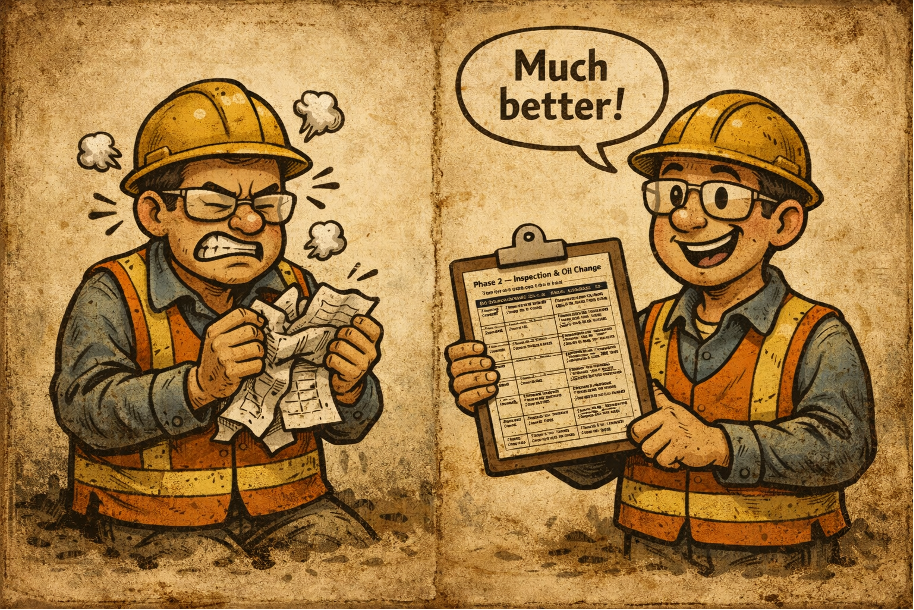
You’ve got a bevy of reliability engineers doing a bunch of analysis stuff on salary. They said you need better PMs.
You hired some consultants—one of your VPs said, with a sage tilt of his head, “We want the gray-hairs advising us on this.” You spent over a million dollars to listen to their coffee cup war stories while a junior engineer and an offshore team spent a year doing “reliability-centered maintenance analysis” and “PM optimization” across your plant.
A senior millwright looked at the product and said, “No %*# kidding that’s how a pump fails. Where are the job plans?” Coffee Cup Bob from The Reliability Guys, LLC: “Well, we just provide scope and interval—the planners still need to plan them and enter them in SAP.”
The millwright, who had indeed told you, says, “Didn’t I effin’ tell ya?” And walks out.
You hire some contract planners to get the PMs in the system. It has been two years now. “We are going to focus on a tiered roll-out. Production-critical rotating equipment first. Those will be ready for field use in February.”
Monday morning, the first set of brand-new PMs hit the schedule. The shift starts with a whimper at 6:30. The Mllwrights East supervisor hands out copies of the day’s schedule. It now says, “3M centrifugal pump PM” instead of “P-123A QUARTERLY.” No work orders printed, no tablets in sight.
The Electricians supervisor has work orders printed out and on desks for some new MCC and motor PMs. The stapled pack is a little bit thicker, if anyone picked it up. One new guy does. The rest rip off the front sheet with the order number and equipment item and head out to work.
Millwrights West are the first to get tablets and they have a change management consultant shadowing them. The tablets have all the work order details, spec sheets, loaded and usable in the field. The new college grad consultant gets in the back of the work truck to head across the tracks to the crew’s first job. “See this shit,” the millwright says, holding up a tablet. “It goes back there with the dead weight,” and drops it on the back bench next to the consultant.
Most of the work orders your organization produces are never meaningfully read by the people who execute them. After all the navel gazing in the office, a technician opens the work order, glances at the equipment tag, and does what he was going to do anyway.
You can skip to the whitepaper or read the blog below.
The Misdiagnosis
This is not speculation. Substantial data from the FAA, the nuclear industry, NIST, and the process industries confirms what every frontline supervisor already knows. The gap between prescribed maintenance and executed maintenance is enormous—and the industry’s response has been to keep writing better prescriptions rather than ask why nobody fills them.
Atul Gawande, the surgeon and author of The Checklist Manifesto, distinguishes between two types of failure. Errors of ignorance: we fail because we lack the knowledge. Errors of enablement: we fail because we possess the knowledge but aren’t enabled to apply it correctly and consistently.
The reliability advice industry mistakes a failure of execution for a lack of knowledge—and keeps selling analysis instead of enablement.
The failure modes of your equipment have been cataloged thousands of times, encoded in OEM manuals, standards, and best practices. You do not need an 18-month FMEA-driven equipment strategy project to discover that pumps fail from seal degradation, bearing wear, and impeller erosion. The real problem is not that organizations lack knowledge. It is that they fail to consistently apply what they already know at the moment a technician stands at a piece of equipment deciding what to look at, what it means, and what to do.
The Scale of the Problem
U.S. discrete manufacturers alone spend an estimated $19 billion annually on unnecessary or ineffective maintenance and lose $119 billion in maintenance-preventable costs and lost revenue. The U.S. process industries conservatively lose at least this amount annually.
An FAA 2022 technical report—reviewing over 380 peer-reviewed sources—found that failure to follow procedures contributes to between 40% and 87% of all maintenance-related safety events. A study of European airlines found 34% of routine tasks performed contrary to written procedures. 80% of aircraft mechanics admitted to deviating from procedures in the previous year. Aviation is the most regulated, most procedure-disciplined maintenance environment on the planet. If those are aviation’s numbers, imagine what’s happening in your plant.
Meanwhile, over 50% of industrial equipment fails prematurely following maintenance work. 68% of failure patterns exhibit infant mortality—elevated failure probability immediately after maintenance. Only 11% are age-related. The industry calls this “preventive maintenance.” The evidence calls it defect roulette.
The workforce that knew how to compensate is leaving. The average age of industrial maintenance technicians is north of 50. The industry faces 2.1 million unfilled manufacturing jobs by 2030. A 24% difference in technician skill level produces a 56% increase in expected downtime. When your equipment reliability depends on which technician shows up that day, you don’t have a maintenance program. You have a lottery.
Why Nobody Reads the Work Order
The instinct is to blame the workforce. Lazy technicians. Poor training. Bad culture. Every consulting presentation on “maintenance excellence” has a slide about “changing the culture.”
The data says something different. The FAA found that over 70% of maintenance manual change requests addressed fundamental quality problems—procedural errors, language errors, technical errors—in the documents technicians are supposed to trust. Many procedures are written by engineers who have never actually performed the task on the real equipment.
When a technician finds errors in documentation—once, twice, repeatedly—trust collapses. Reliance on personal experience becomes the rational response. Then habit. Then culture. Craft hands don’t read work orders because there’s nothing reliable there for them. Planners don’t improve them because no one reads them.
Training doesn’t break the cycle. Cross-industry research shows precision skill training has a half-life of 6 months. But studies also show that reminders during execution—even without previous training—matched or beat the performance of trained groups with no reminders. A 5-item checklist across 103 Michigan ICUs achieved a 66% reduction in preventable infections. The WHO Surgical Safety Checklist cut deaths by 47%. These interventions didn’t introduce new knowledge. Clinicians knew the right steps. They simply didn’t perform them consistently.
The problem is not what technicians know. It is what they have access to at the moment of action.
The white paper details the research behind this across five domains—aviation, healthcare, nuclear power, cognitive science, and manufacturing—with over 450 peer-reviewed sources. What follows is the punchline.
The Punchline
Your “preventive maintenance” program does not prevent anything. Strip away the lubrication and filter changes, and what’s left are inspections: “Inspect pump.” “Check motor.” That is failure finding, not prevention—and it’s done with work orders that provide no criteria for what to look for and no structured way to act on findings.
Actual prevention—the work that stops failures from starting—requires a fundamentally different approach. Not a better analysis methodology. Not a new CMMS. Not another RCM engagement. What scientists call cognitive scaffolding at the point of action: the right knowledge, to the right person, at the right moment, in the right format, to drive the right action.
The white paper lays out four principles that form a prevention hierarchy—from preventing defects at installation, through operational discipline and non-intrusive failure finding, to reserving intrusive work as a last resort. Each is a point-of-action problem solved by reference design, not a classroom problem solved by training. It includes a complete before-and-after application on a centrifugal pump system showing what this looks like in practice.
The Fundamental Asymmetry
The analysis-and-training model concentrates knowledge in people who leave, in binders that sit on shelves, and in CMMS task descriptions nobody reads. The enablement model places knowledge in the environment where it is available at the moment of action—every time, for every technician, on every piece of equipment.
One model degrades. The other improves.
Apprentices using structured diagnostic aids performed comparably to experienced technicians using conventional methods. Every finding the new technician records makes the system smarter. The program improves with use instead of degrading with drift.
The maintenance industry has spent decades and billions of dollars on the wrong side of the problem. The leverage point is the moment a technician stands at a piece of equipment deciding what to look at, what it means, and what to do. Design that moment. The rest follows.
Read the Full White Paper
The Maintenance Execution Gap: The Industry Is Solving the Wrong Problem. What Five Decades of Cross-Domain Research Tells Us.
Based on a systematic review of 450+ peer-reviewed sources, the white paper details why training decays without point-of-action reinforcement, why “preventive maintenance” prevents nothing, how cognitive scaffolding transforms execution, and walks through a complete before-and-after on a centrifugal pump system.
▶
Read the next in the series: Repairs That Do Not Restore
