
RCM x AI = Your Fast Pass to Nowhere
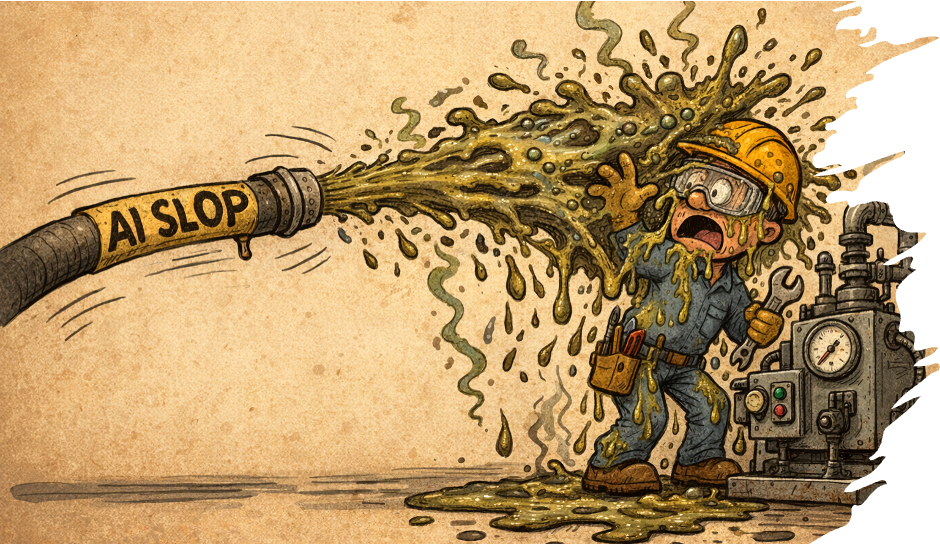
The maintenance advice industry has been solving the wrong problems for decades. Be prepared for a flood of wrong.
There is a $10 billion industry in the United States that aims to help you solve your maintenance problems. They have built careers, business models, and entire market categories around three responses to your reliability problems: more analysis, more training, and better culture.
None of these responses address the maintenance execution gap. None of them links directly to the real world of execution. And now, every one of them is being supercharged with AI.
The pitch is seductive. AI-generated FMEA. AI-optimized PM schedules. AI-powered training content. AI-driven culture assessments.
Take out AI – none of those actions have appreciably improved asset maintenance in decades. Add AI and the failures of these projects will just be faster, shinier, and more expensive.
Speed does not fix a wrong diagnosis.
The Diagnosis Is Wrong
Open your CMMS right now. Pull the preventive maintenance work order for the most critical centrifugal pump in your plant. Read the task description.
In most plants, you will find something like this: PM pump. Check oil. Sample if needed.
That is the entire instruction set for maintaining a pump handling light naphtha at 350°F. A pump whose mechanical seal failure shuts a crude unit within the hour. A pump whose bearing housing depends on an oil film five microns thick — thinner than a human red blood cell — to separate rolling elements from raceway surfaces.
All of the information required for world-class maintenance of this pump already exists. The bearing manufacturer published the tolerances. The seal vendor specified the flush requirements. The coupling manufacturer defined the alignment criteria. The OEM published the installation procedure. API standards define the acceptance criteria. None of it is on the work order.
This is not an analysis problem. This is not a training problem. This is a delivery problem. The knowledge exists. It does not reach the technician at the moment of action, complete with the enablers of time, tools, materials, and the like required for a defect-free repair. That is the Maintenance Execution Gap. And it is what the entire advice industry has been failing to address for four decades.
RCM, plus, plus
The industry's response to your reliability problems follows a depressingly predictable pattern: RCM, plus training, plus culture
The first reflex is more analysis. Reliability-Centered Maintenance is one of the most important intellectual contributions in the history of equipment management. Nowlan and Heap's 1978 study demolished the assumption that equipment wears out on a predictable schedule. That was a genuine insight, built for a specific context: standardized fleets of aircraft with carefully documented equipment items maintained under regulatory oversight.
Your plant is not an airline. A Boeing 747 has approximately 1,500 to 2,500 significant equipment items, each exhaustively documented, with manufacturers who track failure data across thousands of identical units worldwide. Your refinery has 50,000 to 200,000 equipment items, many poorly documented, with maintenance histories trapped in handwritten logs and the memories of people approaching retirement.
RCM produces task requirements. It does not produce execution references. A task requirement specifies what maintenance to perform. An execution reference specifies how to perform it, with acceptance criteria, conditional logic, visual standards, and the failure history that makes the task meaningful. These are structurally different artifacts, and RCM was never designed to produce the second one.
Even when RCM analysis is completed, the results rarely make it to reality. The consultant delivers a beautiful binder. The plant uploads maybe thirty percent. Technicians read none of it. Reliability does not improve. The consultant blames culture. The cycle restarts.
The second reflex is more training. The coupling failed? Send the technician back to alignment training. The bearing failed prematurely? Schedule a lubrication workshop. Research consistently shows that training produces real, measurable gains — when measured immediately after the training event. What happens next is one of the most replicated findings in behavioral science: half the accuracy gains disappear within months. Within a year, most procedural training has decayed to baseline.
The mechanism matters. Training asks the technician to remember. A cognitive scaffold at the point of work asks the system to deliver. The first approach fights human cognition. The second designs around it.
Most technicians learned about torque specifications and induction heaters in trade school. Then they got to the plant and nobody was using them — because the system never put the tools in their hands.
The third reflex is better culture. When analysis does not fix it and training does not fix it, the industry turns to culture. "We need a culture of reliability." "We need an ownership mentality." This is the most seductive answer and the least honest one. Culture is an outcome of system design. You cannot install a culture of precision in a system that provides work orders with no acceptance criteria, shops with no clean preparation areas, and schedules that interrupt technicians mid-task to address the next emergency.
The culture answer places the burden of change on the people who have the least power to change the system — the technicians and operators constrained by the work orders, tools, scheduling practices, and management decisions handed to them. It is the organizational equivalent of telling someone to try harder while standing on their oxygen line.
Now Add AI to Every One of These
Here is what the advice industry is doing right now: taking the same three wrong answers and running them through large language models.
AI-generated FMEA? Faster analysis of failure modes that were already documented and available. The bottleneck was never that we did not know what could fail. It was that we never connected that knowledge to the work order the technician holds in the field. AI-generated FMEA does not close that gap. It generates another binder — a digital one this time — that will sit in your CMMS with the same disconnection from field execution that the paper one had.
AI-optimized PM schedules? Faster optimization of task frequencies for work orders that contain no measurable acceptance criteria, no conditional logic, and no inspection standards. You can optimize the frequency of "PM pump. Check oil." to mathematical perfection, and you have still not told the technician what to look for, what acceptable looks like, or what to do when the condition is not acceptable. You have perfected the delivery schedule for an empty package.
AI-powered training content? More training material generated at unprecedented speed, subject to the same decay curve that has always governed procedural skill retention. The research does not change because the medium changed. Half the gains still disappear within months. The technician still cannot remember the torque specification for a bearing housing six weeks after the training — because they were never supposed to remember it. The system was supposed to deliver it.
AI-driven culture assessments and engagement platforms? A faster way to measure the symptom while ignoring the disease. You do not need to measure whether your technicians feel "empowered." You need to give them a work order that tells them how to do the job at the precision level the equipment requires.
The volume of AI-accelerated slop heading toward your maintenance organization is going to be overwhelming. Every consultancy, every platform vendor, every certification body is racing to bolt AI onto their existing product. The output will be enormous. The impact on your equipment reliability will be zero — because the diagnosis that drives all of it is wrong.
What Is Actually Different
The Maintenance Execution Framework starts from a different diagnosis, which is why it produces a different result.
The diagnosis: more than half of industrial equipment that fails prematurely does so following a maintenance intervention. PM compliance and equipment reliability are barely correlated — at one Gulf Coast refinery, a 44-system analysis showed essentially no relationship. You could have hit 95% compliance and still had your worst reliability year on record. The maintenance industry does not have an analysis problem, a training problem, or a culture problem. It has a delivery system problem. The knowledge exists. The system does not deliver it to the technician at the moment of action.
The Maintenance Execution Framework addresses this with seven enabling conditions. When any one is absent, the system has disabled correct execution before the technician arrives.
The Execution Reference — not a generic task list, but structured guidance at the point of work with acceptance criteria, conditional logic, visual standards, and the failure history that makes the task meaningful. A technician standing at a pump with a work order that says "PM pump. Check oil" and a technician standing there with an Execution Reference containing installation specifications, torque values, alignment tolerances, and pass/fail criteria are not performing the same task. They are working in different systems.
Proper Tools — the precision instruments the job demands, verified and available. Bearing installation requires an induction heater or hydraulic press, not a length of steel pipe. The pipe method transmits force directly through the rolling elements, creating microscopic raceway dents that become initiation sites for spalling. The bearing is new. Its operating life is already compromised.
On-Spec Materials and Fluids — the correct lubricant at the required cleanliness level, components stored under manufacturers' specifications. A bearing that sat on an open shelf in a humid Gulf Coast warehouse for fourteen months is not a new bearing. It is a contaminated component waiting to fail.
Equipment Access — proper isolation and operational condition, not an administrative box to check but a prerequisite for correct execution.
Continuity — protection from interruption during critical work. A technician pulled off a bearing installation to address a production emergency will return to the job with a degraded mental model and a higher probability of error.
Safe Restart — a verified process for returning equipment to service. The most carefully executed repair is one improper startup from failure.
Learning by Doing — data and findings collected from every execution, fed back to improve the system. Not upstream analysis hoping to predict what will go wrong, but downstream learning from what actually happened.
This is not a new CMMS. Not a culture initiative. Not another RCM engagement. It is the operating system that connects engineering intent to field action.
The Asymmetry Nobody Talks About
Here is the fact that should change how you spend your next dollar: the Maintenance Execution Framework is the binding constraint. Remove it and your upstream interventions flounder. Restore it — even without additional RCM analysis, without additional training, without any culture change program — and defect introduction drops, equipment life extends, and reliability improves.
The reverse is not true. You can complete every RCM study, train every technician, and run every culture workshop. If the work order still says "PM pump. Check oil," if the bearing is still installed with a pipe, if the housing bolts are still torqued by feel, if the alignment is still performed on corroded shims without thermal growth corrections — your equipment will continue to fail on the schedule your maintenance system has always set for it.
RCM, training, and culture are not worthless. RCM has produced the industry best practices that we do not need to reinvent for most equipment. Training builds understanding that makes execution references more effective. Culture reflects the seriousness with which the organization treats these systems. But none of them, individually or combined, can produce reliable equipment outcomes without the delivery system that puts precision at the point of action.
The industry has been treating an execution problem as an analysis problem. AI makes it possible to do more analysis, faster, at lower cost. That is useful — if and only if the analysis connects to execution. Without the Maintenance Execution Framework, AI-generated maintenance strategies share the same fate as consultant-generated ones: they sit in a system that no work order references and no technician reads.
The Question You Should Be Asking
Before you sign the next consulting engagement, before you approve the next AI pilot, before you fund the next training program — ask one question:
Does this change what the technician sees and knows at the equipment, at the moment of action?
If the answer is no — if it produces a strategy document, a training certificate, a culture assessment, a predictive model, or an optimized schedule that never reaches the work instruction the technician holds in the field — you are funding another lap on the same track the industry has been running since the 1980s.
The failure modes are documented. The tolerances are published. The OEM specifications exist. The only remaining question is whether the system delivers them to the technician at the moment of action — or leaves them in a binder, a database, or an AI-generated report that no work order has ever referenced.
A consultant who does not understand this distinction will happily sell you AI-generated analysis for the next eighteen months. An AI vendor who does not understand it will happily sell you a platform that optimizes the delivery schedule for empty work orders.
The Maintenance Execution Framework is different because the diagnosis is different. Not more analysis. Not faster analysis. Not smarter analysis. A system that delivers what is already known to the person who needs it, at the moment they need it, in a form they can act on.
That is the gap. Everything else is overhead.
